Profiles
Panthalassa: Harnessing Ocean Power at Terawatt Scale
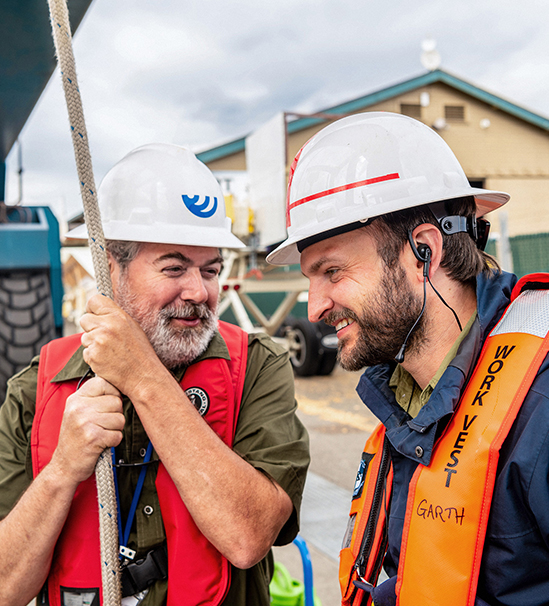
Panthalassa is transforming the ocean’s untapped energy into clean power at terawatt scale. Founded by Garth Sheldon-Coulson and Brian Moffat, the company deploys autonomous floating nodes that convert wave motion into continuous electricity. At scale, this network will unlock abundant energy for AI computing at sea, clean fuel production, and more.
Jul 29, 2025

Powering the Planet From the Oceans
Global energy consumption is projected to reach around 20 terawatts by 2050, with few clean energy sources capable of reaching the massive scale needed to displace fossil fuels. While solar is scaling quickly and fusion is moving from lab to commercialization, one enormous untapped resource remains: the open ocean.
“We started by asking ourselves, what was the way that you could build a platform that supplies half of the planet’s primary energy?” explains Garth Sheldon-Coulson, Panthalassa‘s cofounder and CEO. “The world’s rivers combined are about a terawatt. Tidal ocean currents…very hard to get anywhere close to a terawatt. Even geothermal, it’s very hard to get anywhere close to a terawatt globally.”
Garth and his cofounder, Brian Moffat, knew that others were already working to achieve the terawatt potential of solar, fission, and fusion. As of November 2024, the global installed solar photovoltaic (PV) capacity reached 2 terawatts (TW). Projections show annual solar installations could approach 1 TW per year by 2028, and storage solutions are coming online to translate this intermittent resource into a reliable 24/7 clean energy supply. Meanwhile, fission and fusion offer many tens of terawatts of potential. Companies like Commonwealth Fusion Systems, Xcimer Energy, and Radiant are hitting critical milestones and moving from labs to commercialization.
This analysis led Garth and Brian to the open oceans. Over millions of square miles of sea, waves concentrate wind energy into a dense, reliable power source that runs day and night. “There’s this resource that is totally untapped, very low cost potential, very large scale potential,” Garth notes. “That really excited us. And so we asked ourselves, what’s really stopping us from creating that tech stack?”
Simplicity From the Start
Previous attempts at capturing ocean energy used complex mechanical systems, often tethered to the sea floor. Panthalassa took a radically different approach, seeking to place an energy generation system in the open ocean, where the waves are largest.
“We said we have to reduce this problem to something simpler,” Garth explains. “What we eventually got to was a system that doesn’t require a connection to the seafloor and can be far out in the open ocean, with no moving parts at all, except maybe one water turbine.”
Panthalassa’s hardware, called a node, is a simple, solid state object. Its shape leverages wave motion to continuously force water into a pressurized reservoir inside of the spherical top, which is about 50 meters in diameter. Its neck extends 60-70 meters below the surface of the sea. As waves move the structure up and down, water is pumped through the neck and into the reservoir. It then flows through a single turbine to generate continuous power.
This elegant design can deliver power up to 90% of the time, far exceeding offshore wind’s 30-40% capacity factor, or solar’s onland capacity of about 25%. Garth adds, “All you’re building is a simple steel shell to move water around. We’ve optimized it to the point where the steel, the coatings, the turbine, the power electronics, all of that stuff comes in at about the cost of a natural gas power plant, excluding the cost of the gas. So very, very cheap.”
From Simulations to Sea Trials
Panthalassa’s journey from concept to working technology required an interdisciplinary team of builders hailing from rocket companies, aerospace giants, research universities, naval architecture firms, software companies, metal fabricators, and the armed forces. The team’s diverse backgrounds and their close collaboration have enabled innovations across disciplines. All of the node’s systems, from turbines to power electronics, are tightly integrated and optimized, and built in-house.
Panthalassa’s advanced simulation stack has proven to be a massive unlock for the company. “The leverage that we’ve gotten from simulation is enormous,” notes Garth. “In the early days, we worked out of a wave tank at Oregon State University and would be there for weeks just swapping out buoys and tubes.” With ultra-precise simulation capabilities, the team was able to accelerate learning and optimize development. “Now, we’re running hundreds of those simulations per week,” says Garth.
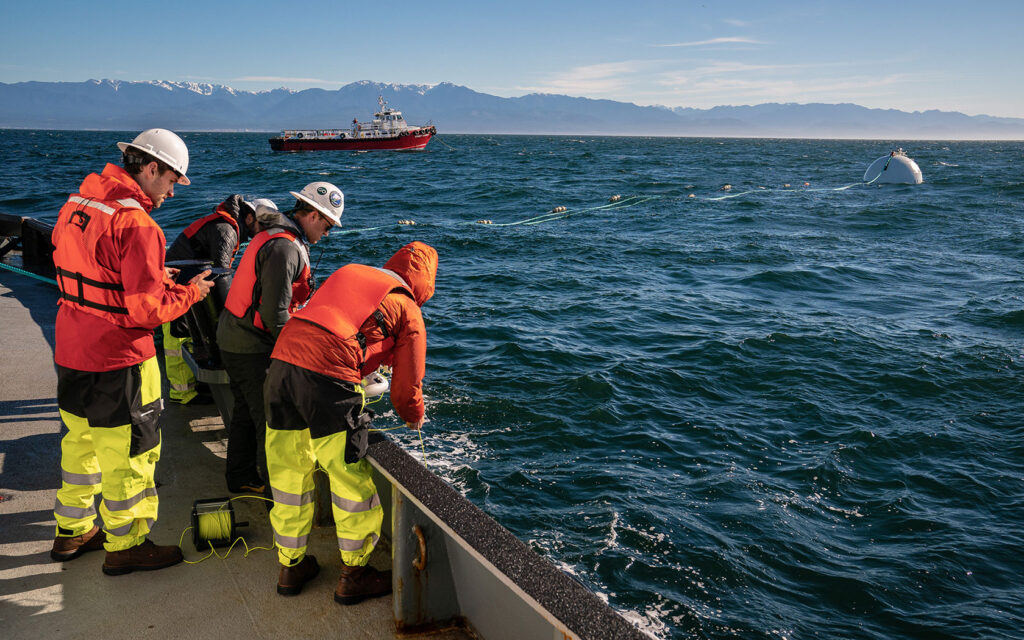
These intensive development efforts culminate in real-life ocean trials that foster strong team cohesion. “You’ve got a team of 10 or 15 people out on tugboats, in hotels, staying in these locations and really burning the midnight oil for months on end to get these systems tested at sea,” Garth recalls. “You’re building these giant machines that take all of this first principles thinking, invention, analysis, and engineering. Then you put it in the ocean and hold your breath, hoping it works. Those trials have been so important for us and built a huge amount of camaraderie among the team building these integrated systems.” In each of their sea trials, Panthalassa’s nodes delivered spot-on results compared to those forecasted during simulation.
Mass Producing Clean Energy Technology
What started as a hunch about the power density of ocean resources has been validated through development. “We didn’t know at the beginning if the costs were achievable,” Garth admits. “But as we’ve gone on, we’ve proven that yes, you can make these machines for down around $1,500 a kilowatt. And that’s all you need to compete with fossil fuel costs and scaled production.”
The best use of this power at sea? “Clean fuels and compute,” explains Garth. For fuels, Panthalassa can make clean hydrogen that ships back to shore on autonomous collection vessels. For computing, the ocean provides an ideal cooling solution, eliminating one of the major costs of operating data centers. Compute hardware sits on board the device, and AI workloads are performed via LEO satellite. The simple design of the nodes means that manufacturing can scale fast: fast enough to provide an alternative to land-based data centers.
“For basically a billion dollars, you can go and build a factory that spits out a gigawatt capacity of nodes every single year,” Garth notes. “The structure is so darn simple, and we can mass produce these units from a single coastal manufacturing facility, building the same thing over and over, that gets you those mass production economies of scale.”
This approach creates minimal strain on existing supply chains. As Mike Schroepfer points out, this is an almost completely orthogonal supply chain to a traditional data center. “Even in our very long run, large-scale scenarios where we’re doing many, many gigawatts of production, we’re only increasing the global steel consumption by a very small fraction,” Garth explains. “In comparison to a car factory, where you’ve got all of these complex elements that have to be brought together. Our factory will be an order of magnitude simpler than that, the capital intensity will be much lower than a car factory, and the scaling rates will be very high.”

Clean Power’s Next Wave of Innovation
Panthalassa is named for the single global ocean that surrounded Earth’s supercontinent Pangea, where ancient life settled, sank, and became the fossil fuels we burn today. By unlocking the power of the open ocean at speed and scale, Panthalassa is changing the equation for companies and communities with net-zero targets in the coming decade and beyond.
The company is currently building its pilot manufacturing facility near its headquarters in Portland, Oregon. As manufacturing capabilities scale up, the implications extend far beyond electricity. Abundant ocean-based energy enables new architectures for AI compute, clean fuels, and heavy industry. Rather than building infrastructure, Panthalassa is manufacturing energy devices, then deploying them at sea, where the platform can expand without the constraints of land and grid expansion, and avoid the bottlenecks of permitting and supply chain congestion.
In a world that needs terawatts of clean, reliable, affordable energy, Panthalassa is not merely deploying a new technology, it’s opening a new frontier.